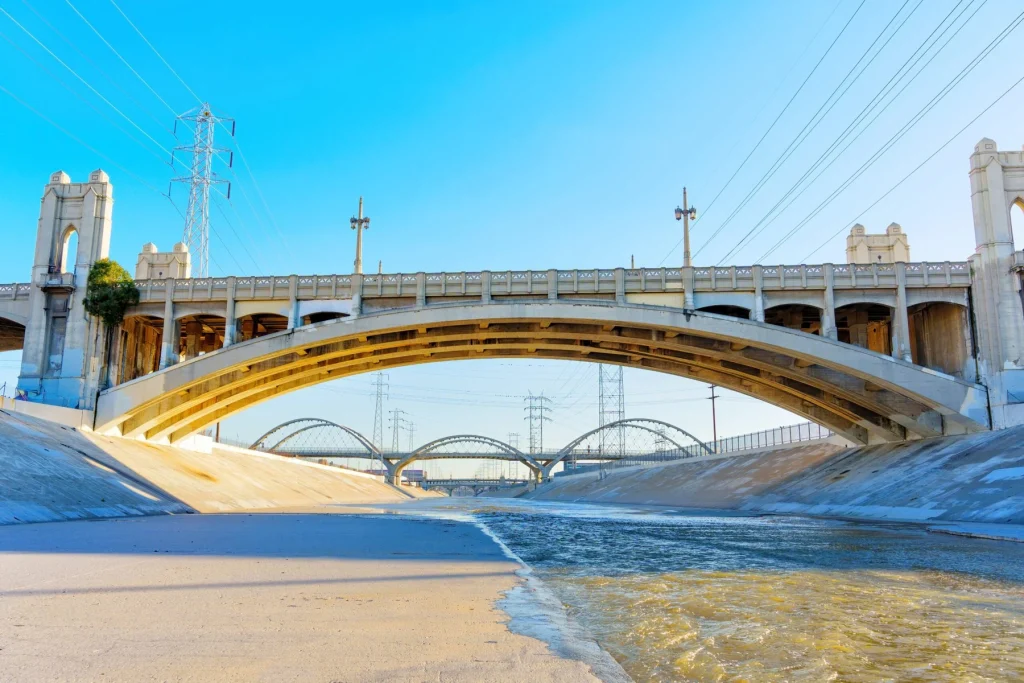
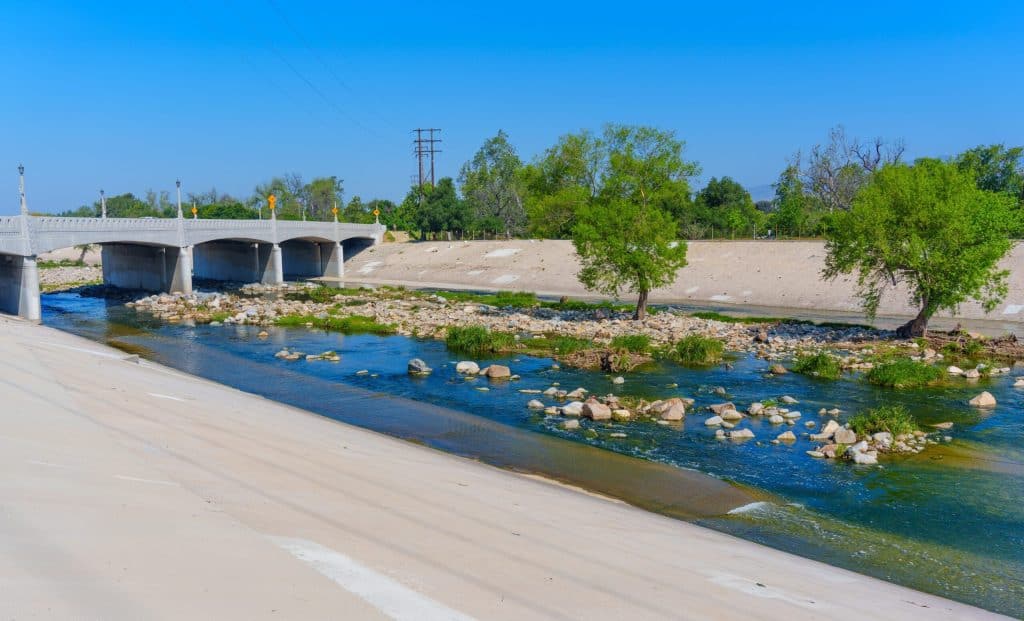
Picture a river that looks more like a parking lot than a waterway. That’s the LA River today. It’s 32 miles of flat gray concrete cutting right through one of America’s biggest cities. Not exactly the stuff of nature shows.
But that’s changing. And honestly? It’s been a long time coming.
What’s the Big Plan?
The Los Angeles River Revitalization Master Plan is one bold idea. The goal: turn all that cold concrete into real, living green space. We’re talking parks, trails, trees, birds — and even fish — all coming back to a river that forgot what it was.
The plan aims to reclaim over 750 acres along the channel. Here’s what that looks like on the ground:
Restored natural habitat for birds and animals
Cleaner stormwater before it reaches the ocean
A connected network of parks and walking trails
Green streets that link nearby neighborhoods to the river
Signature bridges, gateways, and public art throughout
That’s a whole lot of goods packed into one plan.
The river restoration happens in stages. Improvements go in at the top of the bank first. Then the work moves down toward the channel bottom as the city finds better ways to slow and store water. The end goal is to bring back fish habitats — steelhead trout, especially — and get vegetation growing again to support local wildlife.
More Than Just a Pretty Park
Fixing the LA River is great for the local economy, too. The numbers are pretty wild. Estimates put the economic boost at $2.7 to $5.4 billion in new development. Up to 18,000 new jobs could follow. The city could also see up to $81 million more in tax money every year.
Turning a forgotten stretch of concrete into a real community asset pays off big. No small feat for a river most people drive over without a second thought.
Cities That Did It First
Other cities have done it first. Seoul, South Korea, is the best example. All the way back in 1976, the Cheonggyecheon River was covered by a freeway. Not a bridge, a paved-over river. Then, in 2001, the freeway was removed, and the river was returned to the city. Wildlife returned in a matter of years. People also experienced improved air quality and less heat because of the river. 90,000 people visit the river every day.
Napa County is an even simpler example. Napa County was the first to take action on the river. They restored 15 miles of the Napa River and created an additional 135 acres of flood plain. The wildlife came back, the people loved it, and it became the largest wildlife and habitat restoration project in the state. LA has a lot to learn from Napa and Napa County, CA.
Paying for It All
Big dreams need real money. Luckily, LA already has solid funding in place:
Measure W created a property tax that raises about $300 million a year. That money goes toward capturing and cleaning stormwater.
Measure M funded a $356 million central path that runs right along the river.
These are real dollars behind a real plan. The city means business here.
Why You Should Care
Should you live in Los Angeles (or plan to visit), this project will change your perception of the city. Currently, the LA River is largely unknown, obscured by fences and concrete as if trying to hide its presence.
In the near future, it will become the city’s central green lung, offering numerous opportunities for recreation, birdwatching, and riverfront relaxation on sunny afternoons.
The river never went away. It just needs a second chance. And from everything the plans show, that chance is finally here.
In the past, it wouldn’t have been wise to walk anywhere on Industrial Street after dark. There were loading docks, semi-trucks blocking the street, and foot traffic, mostly comprised of unsavory characters. Now, the street has murals, restaurants, and people walk their dogs on it.
The Arts District has transformed rapidly, and it is a story we will likely tell for years to come.
From Warehouses to Art Havens
In the 70’s, the district’s first transformation occurred when artists moved to the area to access cheap studio and living spaces. The area had a rough, gritty feel. The 90s brought crime and vacant buildings, making the area seem even rougher and more undesirable.
The real turning point came in the early 2000s. A company called Linear City took two beat-up old warehouses and turned them into loft buildings. The Toy Factory Lofts opened in 2005 — before that, the massive space had been used to store stuffed animals for a toy company that went bankrupt. Then came the Biscuit Company Lofts in 2007, built on the old Nabisco West Coast base.
Together, they brought around 350 residents to the block. Those residents needed places to eat, drink, and hang out. Businesses followed fast.
“When we opened, it kind of very naturally evolved into a pedestrian environment,” said Yuval Bar-Zemer, a partner at Linear City.
Street Art That Stops You Cold
As you walk through the Arts District, you may lose track of where to look first. The walls of buildings are covered with large, colorful murals. You’ll spot portraits of cultural icons, wild abstract art, and sidewalk drawings that feel totally out of place in the best way. Even if you’re not a big art fan, it’s hard to walk through here without stopping for a photo.
A few spots worth checking out:
Art Share L.A.: a two-story warehouse with art shows, classes, and live-work lofts for local artists
Hauser & Wirth: a converted former flour mill that is a gallery with a garden that has murals, vegetable gardens, and real live chickens
Hidden alleys: cobbled streets that are built over old railway beds and graffiti-covered brick walls. It memorializes the neighborhood’s rough history.
Eat, Drink, Repeat
There is a variety of food available. You can choose between a casual place serving just burgers or a full restaurant without walking more than a few blocks.
Bavel is packed with customers and has great Middle Eastern food. You can’t miss their homemade pita and their homemade hummus. Book a table at Bestia to get a chance at their handmade pasta and their woodfire-baked pizzas. It’s all in the same area, with a lot of competition, and so you need to plan well.
If you want something before dinner, go to Father’s Office for the best burgers and cold beers, or you can even swing by Angel City Brewery, an open-air spot with a lot of history baked into its walls.
Death & Co. is a New York bar that gives you a dark, underground feel. Expect the Flamingo to have pretty pink walls and a floating dance floor. If you want something more chill, the Arts District has plenty of cozy bars that fly under the radar.
Worth the Trip
It took decades of hard work, a few pioneering investors, and many artists’ visions to transform the area, but it paid off in spades. Now the district attracts visitors from near and far, and streets that used to be unsafe at night have become safe. People of all kinds walk the streets and enjoy the district with their children, dogs, and cameras.
Actually, the best way to see it is to show up and walk. You’ll find a mural you weren’t expecting. A cafe tucked into an alley. A bar playing something good. In some corners of a city, you have to earn by just showing up. That kind of place is hard to plan — you have to be there.
Car culture in LA is a serious problem. The entire city is designed around the automobile. The culture of driving a personal vehicle runs deeper than the almost endless freeways. The process of driving a private vehicle in LA is more difficult than finding a parking spot on Sunset Boulevard. But the story of how LA got here is actually pretty fascinating and a little sad.
A City That Once Had It All
At the start of the 1900s, Los Angeles had one of the most advanced public transport systems. The Pacific Electric Railway was the main form of public transport, spanning over 1,100 miles of track and, at its peak, carrying 275,000 passengers. That is more than the New York subway handles today.
Then, in the 1940s to 50s, the focus in America shifted to individual car ownership and a car-owning culture. This led to the construction of the Interstate Highway System. The completion of new highways through Los Angeles provided a direct route to stores and other commercial destinations. As a result of the new highways, public transport was abandoned, and the train lines were dismantled, as the blueprints for the highways intended. The construction of new highways also demolished and destroyed black and brown neighborhoods.
Similarly, in the 1940s and 50s, the abandonment of public transport systems was racist and a result of an untold focus on economic development at the expense of the community.
The average Metro rider brings home just over $19,000 a year
These people aren’t riding for fun. This is how they get to work, to school, to the doctor. They keep the city moving, yet often get the least support in return.
The Fare-Free Experiment
In March 2020, LA Metro took a bold, risky action by creating another fare-free transit system. For 2 years, riders could ride buses and trains for free. It was the largest experiment with a fare-free transit system in the country. Metro’s ridership spike reached levels seen before the pandemic, proving that LA, with its diverse population, is reliant on transit for travel.
This is most likely one of the main factors behind the complete removal of fares. With the removal of the rides’ free transit system, Metro saw a rapid decline in ridership.
Contrary to what most people think, revenue generated does not primarily fund Metro. In 2020, ridership revenue accounted for 6% of the total budget. That means that Metro has 8 billion from other sources to make public transport free.
Why This Fight Matters
The car culture in LA has a cost that touches everyone. It creates congestion that wastes time every week and creates pollution that impacts the economically disadvantaged areas the worst. Those who are most economically disadvantaged and are unable to afford a car incur the greatest cost.
Good transit flips that script. It opens up jobs, schools, and real opportunities across the city. It gets more cars off the road. It cleans up the air. And riding the bus gives you a side of LA you’d never catch from a car window — the neighborhoods, the people, the real city.
So What’s Next?
LA is at a crossroads. Car culture runs deep here. Change takes time. But fare-free transit, better routes, and serious investment in the system could shift things in a big way. The city had an amazing transit system once before.
Hal Miller was a criminal lawyer who died recently. He and my father have been friends since their teens. I knew him but never spoke with him in depth until sometime in the mid-90s, when I was doing a story for the L.A. Times. It was a story about the Eastside Boys, a group of black men born before 1940. My father and Hal were both members, but the latter was the group’s unofficial leader, expert, and historian. His house was like a permanent venue for reunions for years. But the yearly occasion wasn’t just a gathering; it was a homage to black life in Los Angeles in the early part of the twentieth century, which, when looking back, was its best years.
To grasp the magnitude of the gentrification taking over black neighborhoods in metropolitan L.A., it’s necessary to know what the Eastside meant to black people. Of course, not everything was ideal; racist tradition forced blacks to reside in different neighborhoods on the Eastside. The areas on the Eastside were west of Alameda Street and east of Main Street, and are currently called South Central. But despite the circumstances, the Eastside Boys, including Hal and my father, celebrated the gigantic possibility that L.A. seemed to offer, as they saw it from a small view of their surroundings. They celebrated it not only at reunions but every day of their lives.
The city was modern, with a sense of horizontalness, a mixed economy, and inexpensive homes. It looked like a place accessible to everyone, irrespective of color, class, or status, unlike New York or New Orleans. The climate also encouraged people to keep that belief because it’s moderate, and anyone from any climatic region can adjust quickly. The success of the Eastside community in the mid-twentieth century also increased hope for a better life, a hope that seemed to take form for future generations despite segregation.
It did happen; hope turned to reality in one way after the 50s and 60s civil rights movement, but it came with a cost. When restrictions on racial housing disappeared, the white community left the area en masse, leaving blacks in segregation once again. But prosperity continued, especially in the middle-class communities of Baldwin Hills, View Park, Leimert Park, and Crenshaw. These areas were off-limits to black people before.
As white people left the areas, they left Inglewood last and in large numbers. It was a different city for two reasons: first, it had historically opposed integration, and second, it was located at the extreme west if you consider Eastside. Though many white people left, a significant number of households remained even in the 1970s. Many blacks arrived and made the place their home, but the good life didn’t last long. Proposition 13, which limited the funding of various services, including public schools, had a disastrous effect. It later led to the onset of an epidemic in the form of crack cocaine, which was overseen by multiplying street gangs. The wave of immigrants from Mexico and Central America also changed the racial makeup of South Central and Inglewood.
As if all these weren’t enough, the rising cost of housing, sometimes called “the destabilizing force of the 21st century,” poses a threat and may take away any hope of a good life for the black community of L.A. The one factor, “affordability,” which made Eastside thrive, is no longer prevalent. Los Angeles is sharply vertical now, and only the wealthy and elites can afford housing. Besides, race and class are also intertwined, so anything expensive isn’t accessible to blacks as a group. The trend that the Eastside generation and Hal started is reversed now as the famed Los Angeles’ “good life” is scarcely accessible to blacks. The success the Eastside Boys saw and hoped would continue has stalled or been closed in most sectors. Various factors are pushing the black community out of blocks and neighborhoods.
Market Street In Inglewood
Return of White Community
This was an expected crisis, so nothing to be surprised about.
According to a study by the UCLA Luskin School of Public Affairs, the increase in housing costs and the decrease in wages are the two main factors driving the decline of South L.A. The price of houses is more than three times what it was in the 60s. The scarcity of jobs, the high cost of living, and rising home prices are among the reasons gentrification is taking over Crenshaw and starting to envelop Inglewood. The latter has become a much sought-after area in L.A. The real estate business has boomed in recent years, with housing costs soaring at least 63%, according to a study by Property Shark. The research also indicated that the catalog of two-bath, two-bedroom homes conveyed a sense of “suburbanity.”
Gentrification wasn’t an event that Hal and my father imagined when they were growing up in blossoming L.A. It is one thing about white people fleeing and entirely another thing about them returning. The phenomenon has, of course, been reshaping black neighborhoods historically – Bed-Stuy, Harlem, to name a few – but never to such a vast extent as now. It’s a fact to be worried about because the black population of L.A. has gone down to less than ten percent of the total population and poses a danger of being pushed out entirely.
Proposed Future Inglewood Development
The New Inglewood
The danger is more pronounced in Inglewood, where I grew up and reside today. It isn’t an ordinary black neighborhood in L.A. under threat. It’s a city with a 50% black population. But several factors, such as gentrification and impending economic and racial change, look very realistic for a place with its own culture, public image, school district, and government.
Many people, including my neighbors, say that even though gentrification has negative aspects, it’s the answer to reviving our image, which has been tainted for a long time. It’s also the perfect timing for a revitalization. There is plenty of development going on, as the city is home to a huge NFL stadium that will host two teams, the Chargers and the Rams. The surroundings consist of condos, various facilities, retail, and amenities. In a way, it looks like the phoenix rising from its ashes, promising to improve Inglewood. James Butts, the mayor, said that Inglewood is one city that has undergone a vast transformation in only 4 years from being a crime-ridden, jobless, and poverty-stricken city to something worthy and affluent.
However, there is one probable reality lurking around once the development is completed. The designs of gentrification in every area seem to oppose the idea of blacks and Latinos of Inglewood staying around to benefit from the revived city. If nothing is done, then the history of the black community, which thrived even under dire circumstances, could be wiped out.
But there is hope because something positive is happening, and one of the first steps towards that has been regarding the MTA rail line, which is under construction. Crenshaw Subway Coalition, a transportation justice organization founded by Damien Goodman, fought, and now the rail line is accountable to the communities of Crenshaw and Inglewood’s requirements. The organization has been working to oppose gentrification in both areas.
According to the coalition founder, every aspect is being transformed into something white people can accept and like. If it continues, then the people (blacks) who built the place and lived there for decades will be pushed out eventually. To prevent this catastrophe, the coalition plans to form a non-profit community land trust.
More Hurdles Ahead
But it won’t be easy, because black neighborhoods may have missed the opportunity. The leaders and politicians are at fault here because they depended heavily on government funding, but it hasn’t helped. Rather than relying on government financing, leaders could have sought private funding for development. It would have raised living standards and created stable jobs. Another reason for the missed opportunity is that black people often aim low in life just to survive and not to flourish.
If the community had been more forward-thinking and set higher goals, the scenario might have been different. The 1990s were when black neighborhoods could have done something and transformed the city. But that’s long gone, according to Michael Anderson, a developer and an architect.
Now, it seems that only gentrification or the return of whites can make things happen, such as safe streets, good schools, and ideal retailers. What black communities wanted and needed is slowly happening, but it’s coming at a high cost.
My uncle was one of the few people who obtained the Los Angeles dream. He bought a house in the 50s near Slauson Avenue, considered the demarcation line between white and black. His home was in the south of Slauson, and so he had a cross being burned on his property, but he stayed there.
Gentrification has many positive aspects, too. However, it doesn’t do much for black people because it involves them leaving and not arriving. There isn’t any neighborhood in L.A. to go to.